

Pro Sports
Technology
How Advent’s Immersive Cube® is Reinventing Professional Sports Sales & Where The Tech Goes From Here
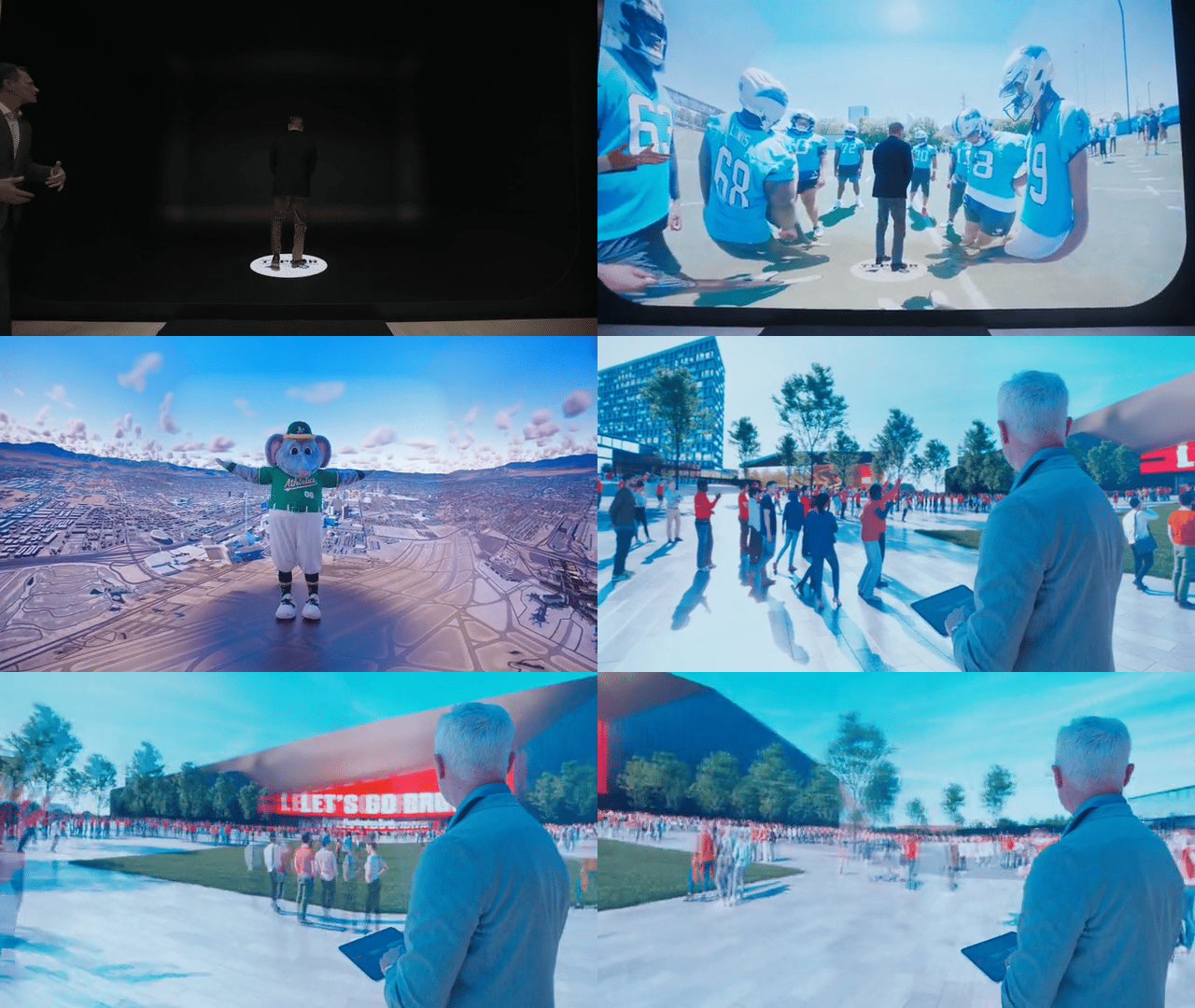
It’s an age-old problem in sports sales. You’re renovating your arena, or building a new stadium. Both projects have long, unpredictable timelines, but you need to start selling now.
For the longest time, the way to sell the new, unbuilt stadium or the arena renovation project draft relied almost entirely on renderings. Flat, two-dimensional, and better for generating buzz than closing deals, renderings have long been the solution in narrowing the “imagination gap” for potential buyers before your space is physically available to them.
Somewhere along the way, virtual reality entered the picture and became something of a go-to solution. The thinking made sense on paper: hand your prospect a headset and suddenly they’re transported inside the rendering.
Seems pretty great, right? It didn’t quite work, and here’s why:
The moment a client puts a headset on, they’re completely alone. They can’t read the room. They can’t watch a family member’s face light up when they see their future seats, or catch a colleague’s reaction when their brand shows up on the jumbotron. They can’t even converse the way you’d want them to – that is, naturally, face-to-face.
Not to mention, people just don’t like wearing those clunky goggles. They’re disorienting, they mess up your hair, they don’t fit glasses-wearers, they’re unsanitary – take your pick.
Enter The Immersive Cube®, which offers a definitive, needed solution to this age-old problem and places pro sports sales clients directly where you want them, even if the location doesn’t exist yet.
Sports Business Journal Columnist Abe Madkour was so convinced after experiencing the “stunning” Cube at the Vegas A’s Ballpark Experience Center, he posited that “teams will copy The Cube® because it is an incredibly effective sales tool, benefiting sellers and buyers.”
As it turns out, Abe was sorta right. Adopt the technology, yes. Copy, no.
Less than a year after we launched our first Cube in Vegas, four more teams have deployed the technology: the Carolina Panthers and Charlotte FC, the Cleveland Browns, and the Jacksonville Jaguars.
Here’s the thing: no two Cubes have been alike – not in their dimensions, nor in the way they’ve been utilized.
Powered by the Advent Operating System™ (AOS), the Cube gives sales reps the option to flip through thousands of different scenarios and content usages, all from the familiar touchscreen of an iPad. Each Cube fits the needs and identity of the team that’s adopted it.
The technology has opened a world of possibilities for pro sports sales teams, delivered outstanding return and, as Madkour predicted, piqued the interest of professional teams across the country.
Here’s how it’s changing the pro sports sales game and where the immersive technology is going from there:
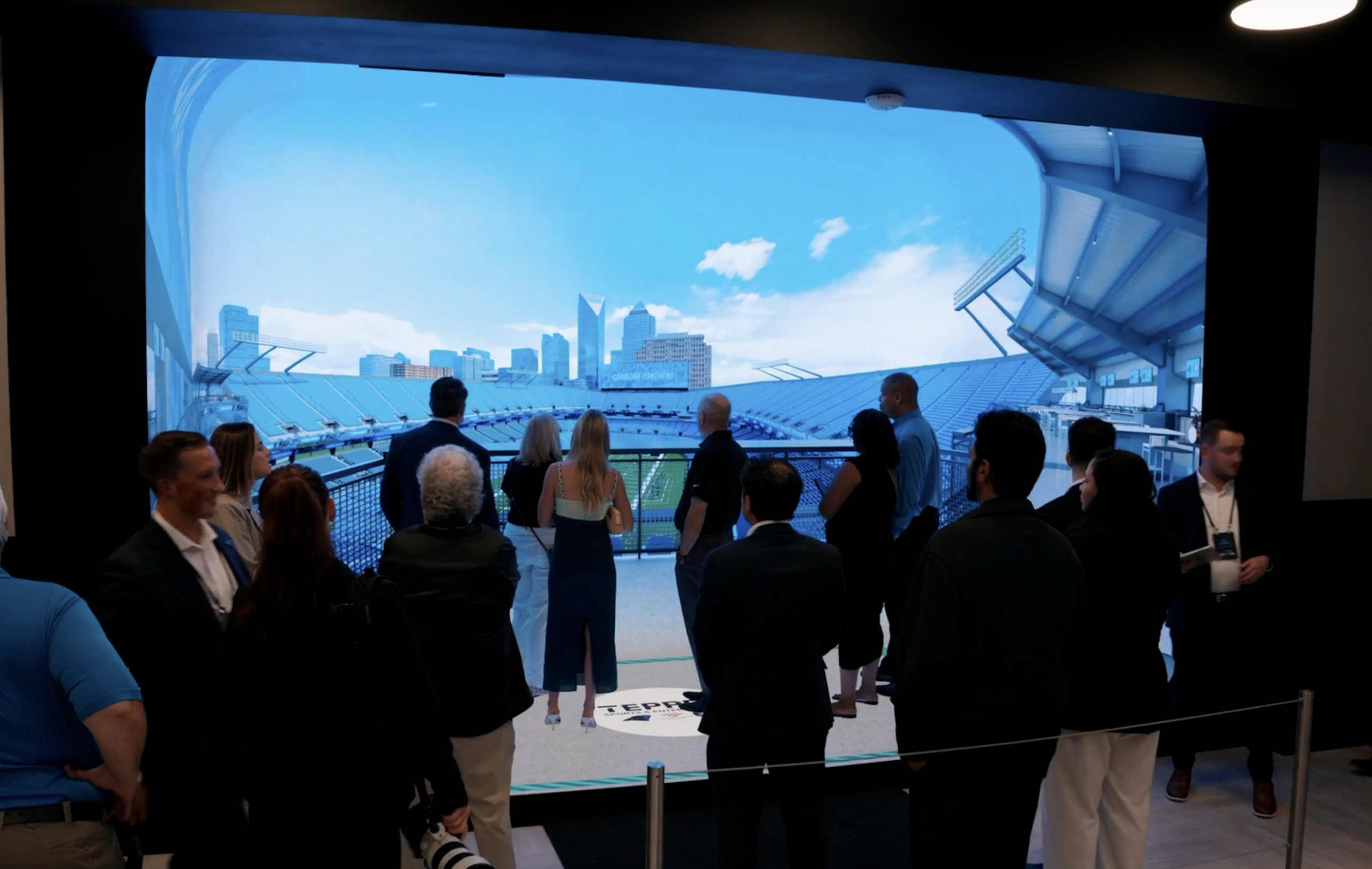
The Immersive Cube is built for shared experience
The isolation problem with VR isn’t just a headset annoyance, it’s a major flaw in what the goggles were supposed to accomplish: getting your client as close to the real thing as possible.
The Cube solves this by delivering a physical, fully immersive experience that’s shared in real time with your family, friends or coworkers.
At 21 feet across – the widest Cube ever deployed – Cleveland’s iteration allows up to 16 guests to step inside at once. That means entire decision-making teams – whether the corporate or familial variety – get to see and experience the vision together.
Think about it: if you’re trying to sell shared experiences, don’t you want your sales journey to be a shared experience too?
The Immersive Cube fits the space you actually have, not the other way around
A lot of sales technology asks you to build around it. The Cube doesn’t work that way.
At the Browns Experience Center, because the space allowed for it, we installed the widest Cube in the world.
In Vegas, the A’s Cube runs a tighter footprint, just under 20 feet across, built to comfortably hold 12. In Charlotte, the Cube is shallower still, engineered to fit the physical envelope of Tepper’s sales center, rather than the other way around. In Jacksonville, the team even opted to make their Cube four-sided instead of five-sided.
None of that is a compromise – it’s a feature.
Gutting and rebuilding a room to fit a piece of technology isn’t solving a problem, it’s creating more of them. The Cube scales to the room, the budget, and the ambition of the project in front of it, which is a big part of why four different organizations, in four different cities, all ended up choosing the same solution.
The Immersive Cube is tailor-made for each and every sales prospect
No two prospects are the same, and the Cube was built with this in mind.
A corporate account interested in looking at suites shouldn’t get the same walkthrough as a PSL holder wanting to know what the sightlines from their seat will be, and the Cube allows reps to customize the sales journey for whoever’s standing inside of it from a few quick taps on an iPad.
The result: the rep has better, quicker information at their fingertips and can answer granular, account-specific questions on the spot, while the buyer walks out of the Cube feeling like their time was valued, their questions were answered, and their experience was built around them personally.
The corporate sponsor sees their logo placement throughout your arena, your VIP lounges or your LED ribbons, your season ticket holder gets to see the view from their seat and the fastest route back home after the game.
Renderings alone simply don’t offer either side anything remotely close.
Once the renovation is complete, once the last suite sells…then what?
It’s a fair question, and one that’s come up directly with some of the teams we’re speaking with: once the ballpark is built, once the stadium renovation is complete and you no longer have to rely on The Cube to sell your spaces – what then? Do you unplug it and close up shop?
Of course not.
The Cube isn’t a temporary pitch tool with an expiration date, nor was it ever intended to be. It’s infrastructure, and infrastructure has a second act.
The most straightforward path is a change in function, not location. The same room that spent two years selling suites to corporate accounts and season ticket holders might become a fan experience center, a gameday destination, a hospitality stop for sponsor activations, or a place for the fans who already bought in to go deeper. Because everything the Cube shows runs through AOS, that shift doesn’t require new hardware or a total rebuild. It just requires new content to be loaded in.
In Charlotte, we’ve already gotten a first glimpse at some of the new ways the Cube can be utilized, as the Panthers and Charlotte FC have utilized unforgettable, live-action 360 footage.
Ever wonder what it’s like to join the huddle or stand in the keeper’s shoes during an MLS match? The Cube can take you there.
Legendary Panthers linebacker Thomas Davis Sr. – retired since 2021 – said the experience in the Cube was the closest he’d gotten to the real thing since hanging up the cleats. If a hall-of-fame caliber linebacker gets chills from it, it’s not hard to imagine what it’ll do for a fan who’s never come close to the field.
Say you want to keep the sales center a sales center and move the Cube elsewhere, like inside the ballpark or on the concourse of the stadium. That’s entirely possible too.
The point is, neither path is the only path: relocate it, repurpose it in place, or some combination of the two. The Cube was never just a sales tool with a shelf life. It’s a platform, and this platform’s second act can be whatever the client needs it to be.
In short: the sales job might end. The Cube’s job never does.
The Advent Takeaway
The Immersive Cube isn’t one product installed the same way every time, and it isn’t just a bigger, better screen either. It’s a platform that brings your renderings to life without the barrier VR put between sales reps and buyers, adapts in real time to whoever’s standing in the room, fits whatever space and budget a team actually has, and keeps working long after your project becomes reality.
That’s not just a better sales tool. That’s a different sales journey entirely, and it’s why Abe Madkour’s prediction is already proving out three times over.
If your organization needs buyers to feel a future that hasn’t been built yet, this is exactly the kind of problem we solve. Let’s talk.

Written by Kat Fincher, Senior Client Engagement Manager
For over 25 years, Advent has been creating emotionally resonant experiences for leading brands including AT&T, Fanatics, the Dallas Cowboys, and Stanford University. Our proprietary StoryMining methodology ensures that every project starts with the story, not the technology.