

Digital Experiences
Experience Design
Halls of Fame
Multi-Use Districts
Thought Leadership
The Experience Economy Is Not a Trend. It Is the Competitive Frontier.

I’ve spent over three decades helping organizations close the gap between the brand they think they have and the experience they actually deliver. And the one thing I can tell you with certainty is this: the organizations that treat experience as a department or a campaign are already falling behind the ones who treat it as a strategy.
This is not a trend. Trends fade. What we are witnessing is a fundamental restructuring of how value is created, how decisions get made, and how loyalty is won and lost. Pine and Gilmore named it the Experience Economy back in 1999 and the academic and business world has spent the years since catching up to what they described. The question is no longer whether experience matters. The question is whether your organization is intentional about it.
Nowhere is that question more urgent than in sports. Teams, venues, and franchises are sitting on some of the most powerful emotional raw material on earth: tribal identity, generational loyalty, the shared electricity of a crowd. The organizations that learn to design around that material will create something that no other investment can replicate. The ones that don’t will keep watching fans walk out the door and wondering why.
From Commodities to Experiences: The Economic Shift Sports Can No Longer Ignore
Pine and Gilmore’s model traces a progression: commodities become goods, goods become services, and services become experiences. At each stage the value creation multiplies, but so does the expectation. Researchers Mehmetoglu and Engen, writing in the Journal of Quality Assurance in Hospitality and Tourism, confirmed that this framework isn’t theoretical. Their empirical work demonstrated that different experience dimensions drive visitor satisfaction in measurable, statistically significant ways, and that the dimension doing the heaviest lifting shifts depending on the context and the audience.
For sports, this is instructive. A ticket to a game is not a commodity. But it can become one. When the in-stadium experience fails to engage, when a fan’s connection to the team lives entirely in the broadcast and not in the building, that ticket starts to feel like a transaction. And transactions are easy to walk away from.
The four dimensions Pine and Gilmore identified, education, escapism, aesthetics, and entertainment, are all present in a live sports experience. The question is whether they’re being designed or merely hoped for. A fan absorbing the spectacle from their seat is in the entertainment dimension. A fan exploring an interactive hall of fame, learning the history of the franchise, has crossed into education. A fan standing inside the arrowhead logo at Arrowhead Stadium, surrounded by the architecture of belonging, is fully immersed in the aesthetic and escapist dimensions simultaneously. That’s what Pine and Gilmore called the ‘sweet spot.’ It’s where all four dimensions converge, and where experience becomes something that cannot be replicated on a television screen.

The Brand Doesn’t Live in the Building. It Lives in Their Heads.
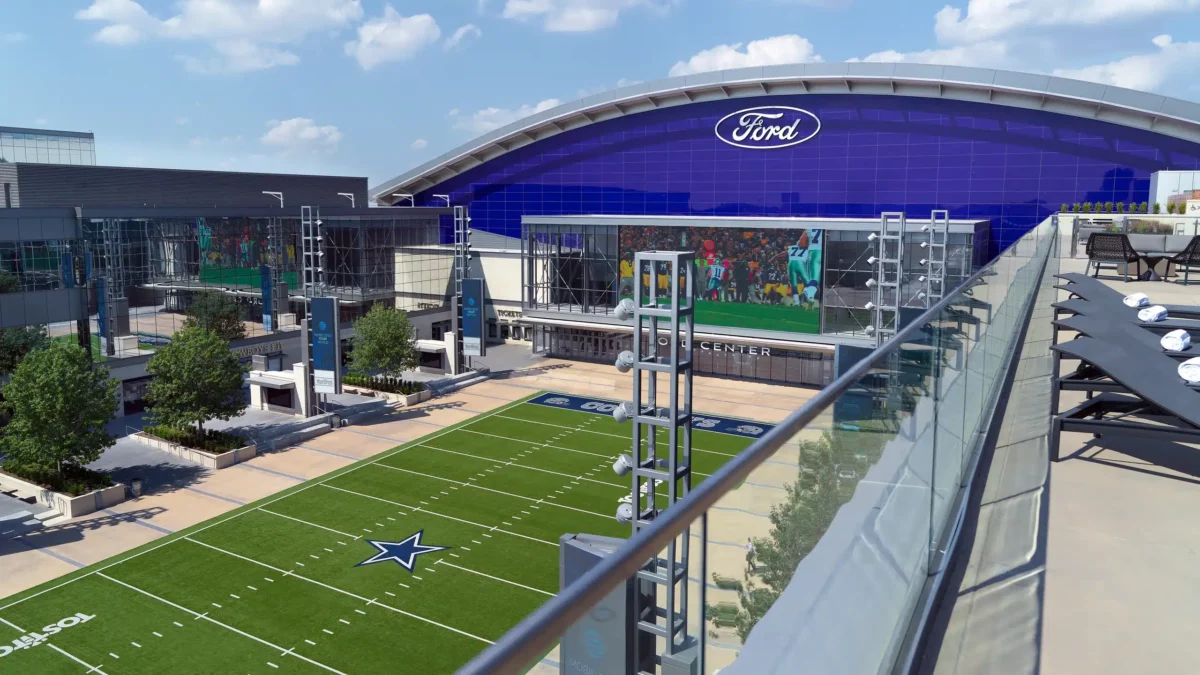
I stood in the parking lot of the Dallas Cowboys’ Valley Ranch headquarters facility in 2014, expecting to feel something proportional to what that franchise represents in American sports culture. I didn’t. The gap between what the brand promised and what the physical space delivered was jarring. That gap is where brand value either thrives or dies.
“Brand is a collection of stories, positive and negative, in the mind of the audience that add or subtract value and enable choice. You can’t dictate perception, but you can influence it. Not through your logo, or a tagline, or an inflated marketing budget, but through your brand experience.”
— From my upcoming book, The Experience Code: Harnessing Story and Data to Move People
Jerry Jones understood this instinctively. He didn’t just build The Star in Frisco. He built a three-dimensional manifestation of the brand that already existed in people’s minds. He closed the gap. The Cowboys are now valued at over $13 billion, not because they’ve won more recently, but because Jones understood that perception is value, and that experience is the mechanism by which perception is shaped.
Every sports organization is sitting on a version of that same opportunity and that same risk. The franchise that invests in experience is not spending money on aesthetics. It’s investing in the most durable form of brand equity that exists: the story a fan carries in their head, and tells to everyone they know.
Belonging Isn’t a Nice-to-Have. It’s the Business Model.
When we work with sports organizations that are struggling with attendance, fan engagement, or declining sponsorship interest, I often hear the same framing: how do we get more people to come? I want to reframe the question. The real question is: why do people feel they belong here?
“Since the beginning of anthropological time, humans have belonged to tribes. We’re wired for it. Programmed for it. And in our modern world, where traditional tribes have dissolved, we’ve transferred that primal need to brands, teams, causes, institutions. When someone paints their face in team colors, when they tattoo a logo on their body, when they name their child after a player, that’s not consumer behavior. It’s tribal identity.”
— From my upcoming book, The Experience Code: Harnessing Story and Data to Move People
The research on experience economy reinforces this. When Mehmetoglu and Engen examined what drove visitor satisfaction across different experience contexts, they found it wasn’t the features of the product itself. It was whether the experience engaged the visitor personally, whether it created a meaningful emotional response, and whether it left them with something beyond a memory. Those findings translate directly to what we see in sports facility design.
At Arrowhead Stadium, we didn’t just update displays for the Kansas City Chiefs. We created a space where fans could literally stand inside the arrowhead logo. That’s not a design decision. That’s a belonging decision. It says to every fan who walks in: this isn’t just about the team. It’s about you. Your story intersects with this story. You’re not a spectator here. You’re part of it.
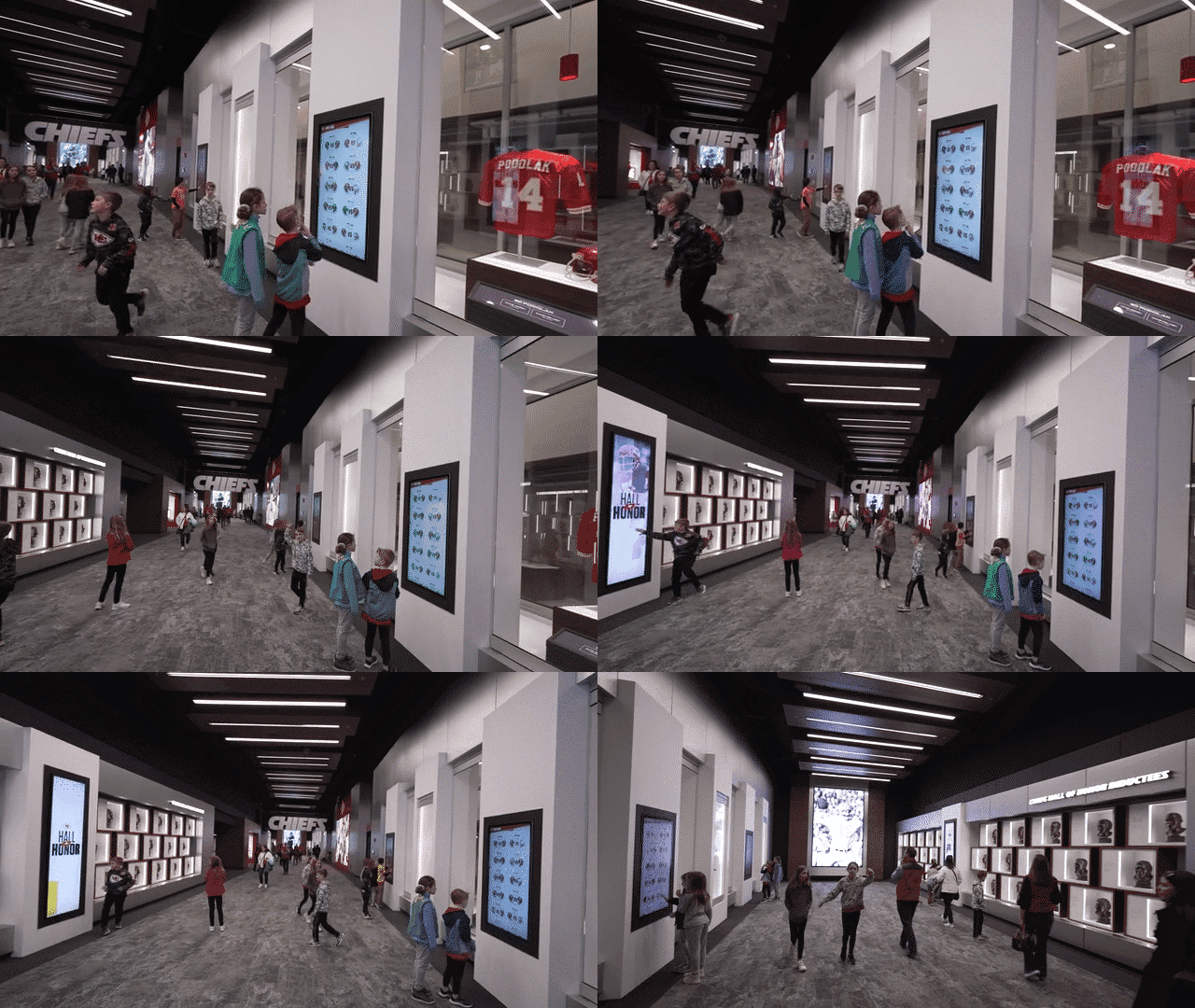
The University of Texas Athletics Hall of Fame operates on the same principle. We brought together trophies and stories from different sports and different eras that had been scattered across campus and created the largest hall of fame in college sports. But the power of that space isn’t in its size. It’s in the intentional removal of the glass from the trophy cases, so fans can actually reach in and touch the Heisman trophies. The moment they do, the story changes. It stops being the university’s story and becomes theirs.

The Four Dimensions Playing Out in a Stadium Near You
When we think about applying Pine and Gilmore’s framework to sports venues specifically, the implications become practical very quickly. Escapism, the dimension that produced the strongest effect on satisfaction in the Ice Music Festival research, is exactly what a great live sports environment should manufacture. The fan who walks into your building should feel like they’ve crossed into a different world, one governed by the heightened logic of competition and community rather than the routines of daily life.
Aesthetics, the dimension concerned with how surroundings shape the experience, is often where sports organizations underinvest or misinvest. We teach our clients to think of brand elements like diamonds. They’re precious because they’re scarce. A facility drenched in your brand color doesn’t communicate pride. It communicates desperation. Strategic use of visual identity, creating moments of impact rather than wallpaper saturation, is what makes a space feel powerful rather than desperate.
Entertainment is the dimension most organizations default to. The video board, the music, the between-play content. These matter. But entertainment alone doesn’t build loyalty. Fans who are merely entertained are fans who will stay home when the team is losing. Fans who belong come anyway. The work of retention, the work of sponsor value creation, the work of talent recruitment, all of it depends on building beyond entertainment into the deeper dimensions.
Education, the fourth dimension, is where sports organizations have the most untapped opportunity. The heritage of a franchise, the stories behind the numbers, the human narratives that explain why this team, this city, this community exists in relation to each other, all of that is content. It’s not nostalgia. It’s identity infrastructure. Fans who understand the depth of what they’re part of become the kind of advocates that no advertising budget can manufacture.
The CARE Framework: An Architecture for Moving People
At Advent, we’ve distilled three decades of designing experiences across more than 2,500 projects into a framework we call CARE. It emerged from the patterns we saw in what actually worked, not just aesthetically but commercially, in terms of measurable outcomes across donor retention, sales conversion, enrollment, and sponsorship.
“Every experience that truly moves people follows the same pattern: Captivate, by breaking the visitor’s pattern and interrupting their autopilot. Amplify, by making the story experiential rather than informational. Resonate, by designing for emotion and not just function. Empower, by letting the audience co-create, share, and own the story. CARE isn’t sequential. It’s symphonic. All four elements play together.”
— From my upcoming book, The Experience Code: Harnessing Story and Data to Move People
For a sports venue, this translates to a set of concrete design questions. What is the moment in this building that breaks the visitor’s expectations? What story does this space tell that visitors can only experience here, in person, in this building? What emotional truth does this franchise carry that your audience already believes but hasn’t seen reflected back at them? And how does the space invite fans to become participants rather than spectators?
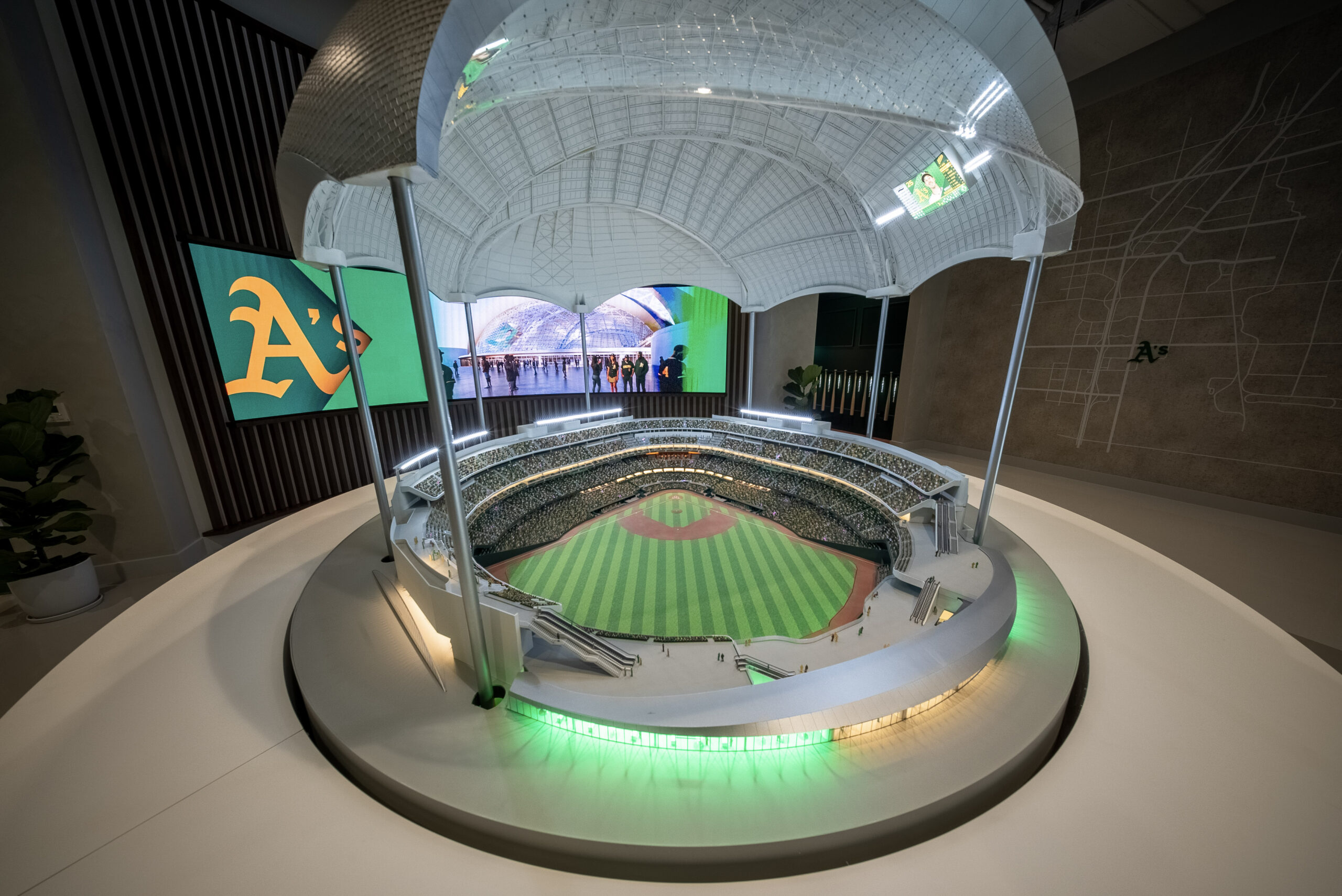
The A’s application of immersive technology at their new facility is a direct expression of the Empower dimension. When a prospective season ticket holder or suite buyer can stand inside a three-dimensional simulation of the ballpark, surrounded by the sights and sounds of a full game-day atmosphere, before the stadium is even built, the decision calculus shifts. They’re not evaluating a purchase. They’re making an identity commitment. That’s the difference between selling seats and creating belonging.
What This Means for Sports Organizations Right Now
COVID accelerated a reckoning that was already coming. Fans discovered, to no one’s particular surprise, that they could watch games at home. The question that the pandemic forced into the open is the same question experience economy researchers have been asking for decades: what does the physical presence of the fan actually provide that cannot be replicated elsewhere?
The honest answer is: it provides belonging. It provides the experience of being inside the story rather than watching it from the outside. It provides the tribal ritual, the collective breath held before a crucial play, the shared eruption of a crowd. None of that transfers to a screen. But none of it happens automatically in a building either. It has to be designed.
The organizations that are winning this fight are not the ones with the biggest video boards or the most aggressive marketing budgets. They are the ones who have done the hard work of understanding what their fans actually feel, what stories their audience carries about the franchise, and how the physical space can be designed to answer Oprah’s three questions with a resounding yes. Do you see me? Do you hear me? Does what I say matter?
“When organizations answer those three questions authentically, consistently, and genuinely, something shifts. The transaction becomes a transformation. The purchase becomes a pledge. You don’t just have fans. You have family.”
— From my upcoming book, The Experience Code: Harnessing Story and Data to Move People
Sports teams have always known that fandom is emotional. The Experience Economy confirms what we’ve seen in project after project: that emotion, properly designed for, is not just a nice outcome. It is the entire business model. The franchise that treats experience as strategy will build the kind of fan equity that survives losing seasons, outlasts player departures, and generates the sponsorship value and talent attraction that makes sustained success possible.
The competitive frontier isn’t on the field. It’s in the building. And it’s designed.

For over 25 years, Advent has been creating emotionally resonant experiences for leading brands including AT&T, Fanatics, the Dallas Cowboys, and Stanford University. Our proprietary StoryMining methodology ensures that every project starts with the story, not the technology.