

Higher Education
Technology
Fall Leaves in July: How Universities Are Using Immersive Tech to Win Over Prospective Students, Donors, and Partners
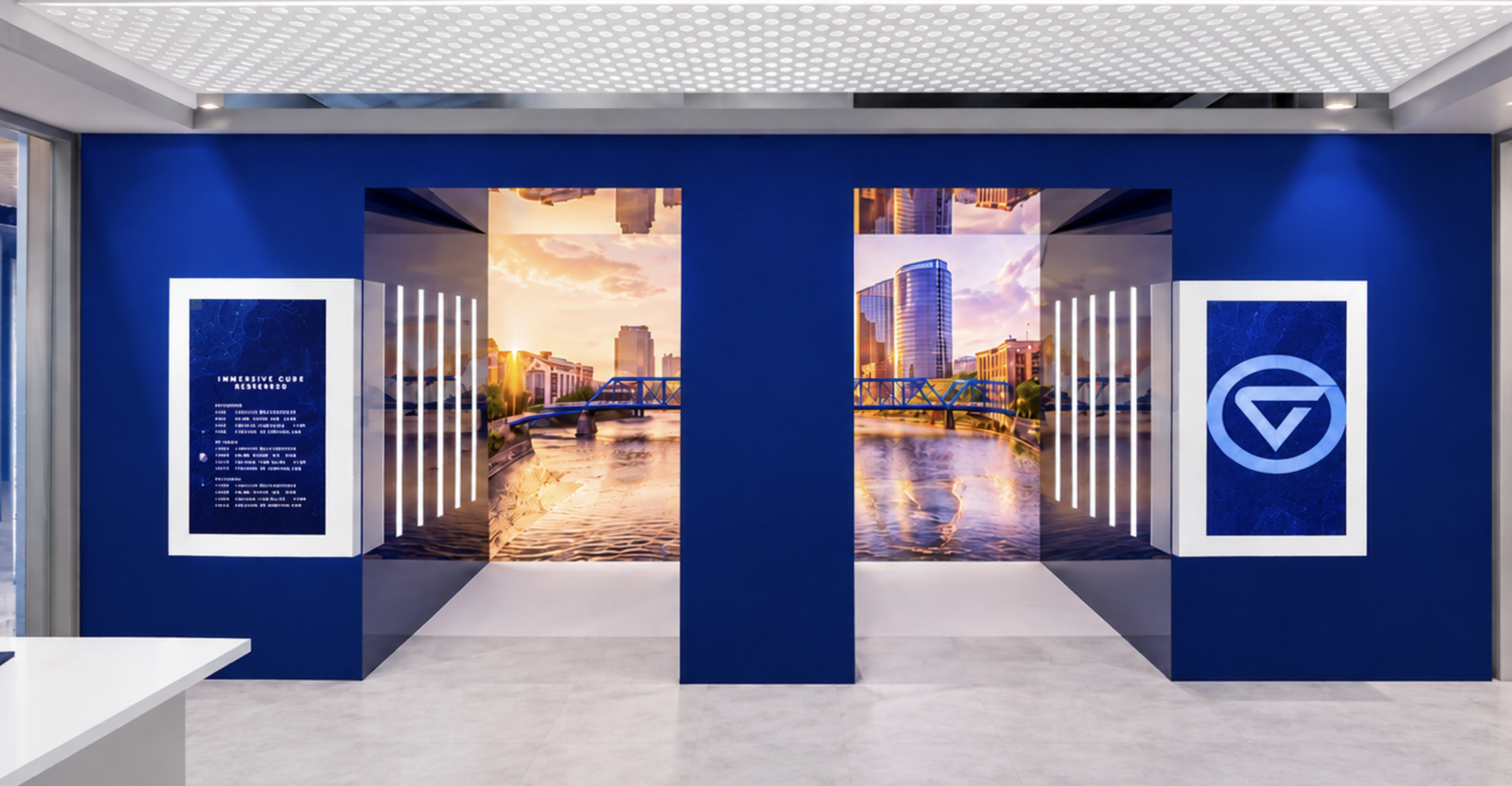
Imagine walking a prospective student and their parents into a campus welcome center on a quiet, humid afternoon in mid-July. With a single tap, the windowless conference room disappears. Suddenly, they are standing in the middle of a bustling quad surrounded by peak autumn foliage, hearing the roar of a packed game-day student section, and stepping directly inside a restricted research lab. All of this happens in less than sixty seconds.
For decades, universities have relied on static brochures, architectural renderings, and weather-dependent walking tours to tell their story. Today, those tools are not enough. Higher education is competing harder than ever for three distinct groups: prospective students, philanthropic donors, and corporate industry partners. Each group needs to feel the future of an institution before they commit to it.
To close that gap, universities are adopting the 270-degree immersive experience model that has already been proven in major professional stadium developments. This approach turns ordinary rooms into responsive, room-scale storytelling engines. Below, we will examine the challenges institutions face, highlight how Grand Valley State University is bringing this vision to life, and share five practical steps universities can take to deploy immersive spatial technology across the entire campus lifecycle.
Solving Higher Ed’s Timing and Access Problem
Higher education institutions are competing harder than ever for three critical groups: philanthropic donors, corporate industry partners, and top-tier prospective students. Yet, universities face a persistent timing and access problem. It is difficult to rally donor momentum around a multimillion-dollar facility that is still years away from opening, challenging to show corporate partners complex research in action, and nearly impossible to capture the true energy of campus life when a family visits during an off-peak summer afternoon.
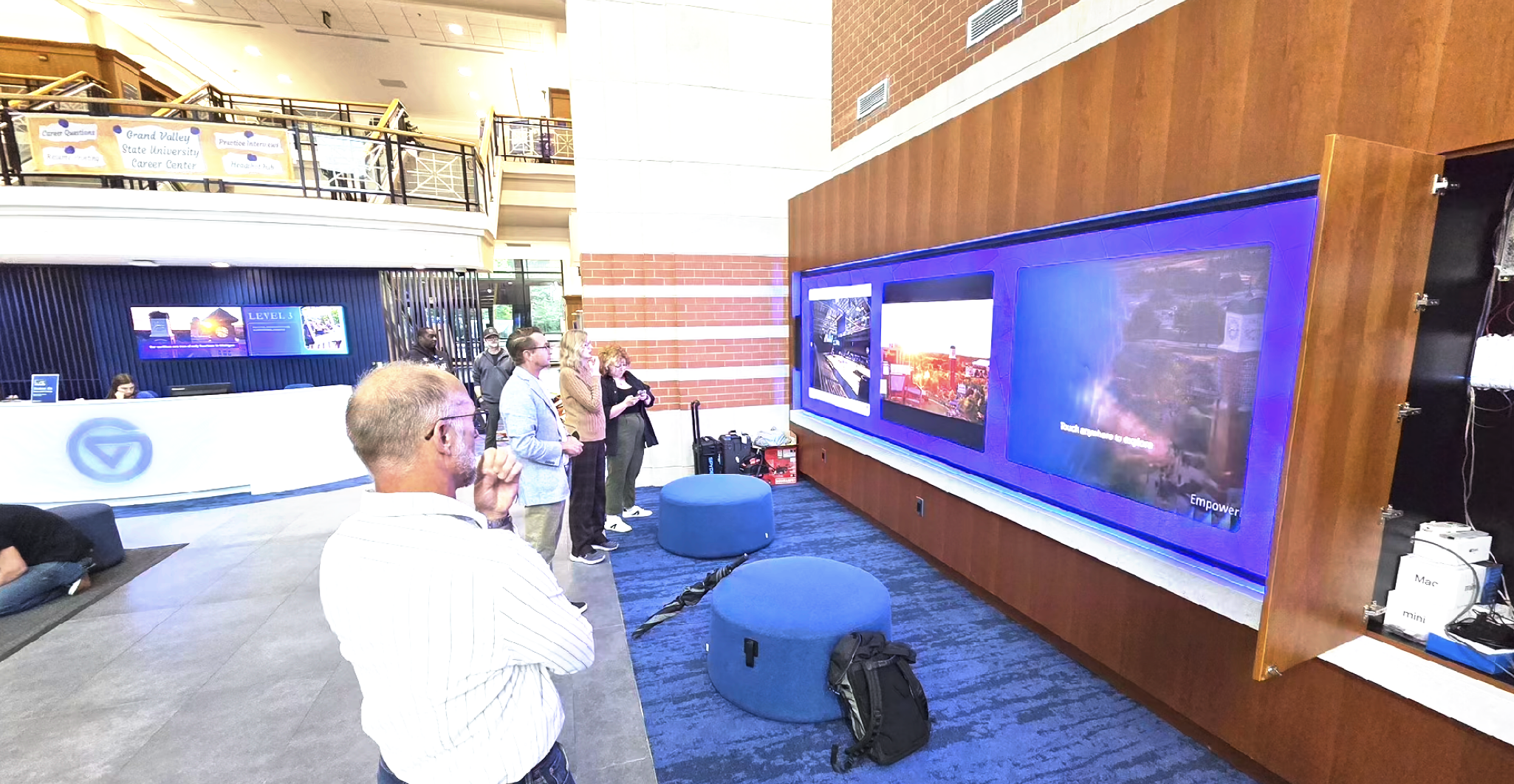
Grand Valley State University (GVSU) is tackling these exact challenges head-on with its upcoming Blue Dot Innovation Lab in downtown Grand Rapids, slated to open in 2029. While the facility is still in its early conceptual and construction phase, GVSU is integrating The Immersive Cube® as a centerpiece of its vision. Initially, the Cube acts as a high-impact stakeholder and donor preview space, allowing supporters to step inside the facility before the walls are even up. Once the building opens, it transforms into a living academic canvas where students create content, faculty visualize complex research, and corporate partners collaborate on real-world technology.
Powered by 26.5 million pixels across walls, floors, and ceilings and driven by the Advent Operating System™ (AOS),The Immersive Cube® turns passive spectators into active participants. Advent helps universities deploy a single, modular spatial asset that evolves alongside the institution—seamlessly shifting from a capital campaign engine to a hands-on student lab and an unforgettable undergraduate admissions tool.
5 Ways Universities Are Deploying Immersive Storytelling
1. Sell the Future Before Breaking Ground
Blueprints, architectural fly-throughs, and 2D renderings rarely spark deep emotional investment. Before a new facility opens, universities can use immersive spatial visualization to walk donors, trustees, and community leaders through the finished space. Letting supporters physically feel the scale, energy, and purpose of their investment builds fundraising momentum years ahead of ribbon-cutting.
2. Turn Passive Spaces into Living Student Canvases
Campus technology shouldn’t live behind velvet ropes. Forward-thinking institutions design immersive installations to transition on “Day One” of building occupancy into active, interdisciplinary sandboxes. Students in computing, digital media, engineering, and design can use the space to build, test, and showcase their own real-time simulations and creative projects.
3. Defeat the Calendar in Undergraduate Admissions
A campus tour shouldn’t depend on the weather or the academic calendar. Equipping admissions welcome centers with instant theme-switching capabilities allows a family visiting in July to step onto a vibrant fall quad, feel the electricity of game day, or explore customized scenes tailored to a prospective student’s intended major.
4. Unlock Off-Limits and High-Tech Environments Safely
Many of a university’s greatest differentiators (cleanrooms, wet labs, cyber ranges, or specialized engineering facilities) are off-limits to visitors due to safety, privacy, or capacity constraints. 270-degree environmental storytelling brings prospective students and corporate partners directly inside these high-touch spaces without disrupting active research or compromising safety protocols.
5. Build for Multi-Audience Agility via Software, Not Hardware
Single-purpose presentation rooms quickly become obsolete once a capital campaign ends. By pairing modular hardware with an agile content management platform like the Advent Operating System™, institutions can pivot a single room from an executive corporate pitch in the morning to a student workshop in the afternoon and an admissions showcase on the weekend.
The Advent Takeaway
Higher education is no longer just competing on facilities—it is competing on connection, vision, and lived experience. As pioneers like Grand Valley State University are demonstrating with the Blue Dot Innovation Lab, the most forward-thinking institutions are replacing static presentations with adaptable, 270-degree storytelling environments that serve every stage of the university lifecycle.
At Advent, we help colleges and universities turn physical spaces into dynamic engines of belonging. We give donors a reason to believe, students a canvas to create, and prospective students a chance to see themselves on campus before they ever enroll.
Ready to bring your campus vision to life? Let’s connect.

Written by Grace Johnson, Senior Client Engagement Manager
For over 25 years, Advent has been creating emotionally resonant experiences for leading brands including AT&T, Fanatics, the Dallas Cowboys, and Stanford University. Our proprietary StoryMining methodology ensures that every project starts with the story, not the technology.