

Experience Design
Why Losing a Deal Might Be the Best Thing That Happens to Your Team
There is a specific kind of quiet that settles over a room after you get the call that a project fell through. You spent weeks pouring energy into the vision, rallying your team, and picturing the final design, only to hear that the client is going in another direction. It stings, and no matter how seasoned your team is or how many wins you have under your belt, failure is inevitable.
In those moments, it is tempting to replay every detail and obsess over the outcome. After 23 years as an executive at Advent, I have learned not to waste energy fighting a decision that is already final.
True resilience is about how quickly you recover, adapt, and keep your team moving forward after a hit. For me, that starts with having enough humility to admit you do not have all the answers and asking two simple questions: Did we do everything we could to present ourselves authentically? And what can we learn to be better next time? Sometimes the cards are stacked against you from the start, and other times the lesson is sitting right in front of you, if you’re willing to look for it.
Here is a look at what a recent loss taught us about slowing down, how we turn those missteps into a habit of accountability, and how applying those lessons creates stronger client partnerships.
The Cost of Skipping a Step
Not long ago, we lost a project right after completing some early concept development. New leadership stepped in midstream with a completely different vision than the one we had been briefed on at the start. It felt like the target moved right as we were taking our shot. To make matters worse, an early call with one of their project partners didn’t go well, leaving a sour taste before we even got to the creative work. When new leadership saw our initial concepts, we weren’t on the same page, and he decided to pull the plug rather than move into revisions.
Our immediate response was to own it and ask questions. We apologized that the partner call didn’t go the way he wanted and that our first round of concepts missed his vision. We even offered to get back on a call with the partner and bring in an executive to help bridge the gap. He wasn’t interested. So, we shifted to learning mode and asked a lot of questions about what specifically wasn’t working in the designs. The honest answer is everything he disliked could have easily been fixed in the next round.
When I sat down with the team to unpack the loss, we realized two big things. First, the project was never really the right fit. We had been referred in by a current client, but the scope wasn’t really in our wheelhouse, and we were getting conflicting directions from too many stakeholders.
Second, and most importantly, we broke our own process. Because the client was frustrated about that rocky partner call, we were on our heels. When they asked to see designs quickly, we tried to overdeliver and make up ground by skipping a critical step: the Strategy Presentation. Normally, that is the checkpoint where we play back “what we heard” and share loose concepts to make sure we’re aligned before diving into heavy design. Instead, we combined the strategy phase with the initial concept presentation.
We acted with a sense of urgency, which is usually a great trait, but we forgot to pump the brakes and make sure everyone was looking at the same map. Walking away from that table, nobody was mad and nobody lost sleep over the loss. It stung in the moment, sure, but realizing we had abandoned our own playbook to chase speed was a lesson worth its weight in gold.
Celebration of Mistakes (C.O.M.)
I once read that if you make the same mistake repeatedly, it’s no longer a mistake. It’s a choice. Resilience requires more than just shaking off a loss; it requires changing your behavior so you don’t repeat it.
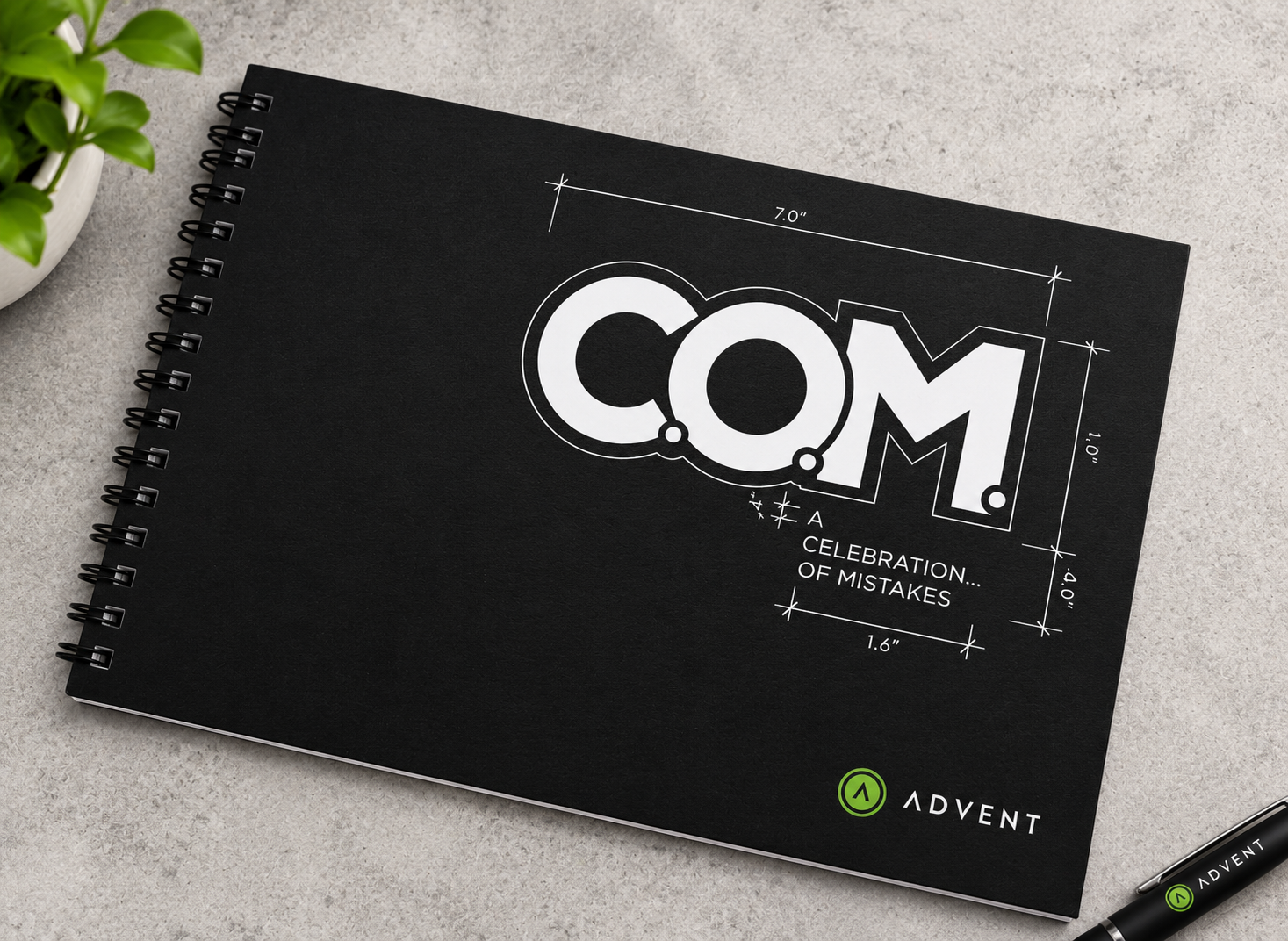
To make sure lessons actually stick at Advent, we use a system called C.O.M. (Celebration of Mistakes). Once a month,the entire team gets together, and everyone shares one mistake they made and what they learned from it. Everyone participates, including me. When the leadership team goes first and owns a misstep in front of the room, it lowers everyone’s guard and builds psychological safety. People stop hiding errors out of fear and start dissecting them out of curiosity.
The goal isn’t to embarrass anyone or hand out participation trophies for messing up. It’s about transparency and collective growth. If I make a mistake and share how it happened, the rest of the team doesn’t have to learn that lesson the hard way. It’s become such a foundational part of how we operate that we actually compiled these lessons into a physical book for the team to reference.
Holding the Line Without Losing the Relationship
You know those lessons are working when you apply them to your toughest accounts. We have one client who is notoriously difficult to please, and they also happen to be one of our longest tenured relationships. I always tell the team: It’s called work because it isn’t always easy. If it were easy all the time, it would be called vacation.
Early on, a client like this could easily push a team into reactive mode, rushing to hit arbitrary dates or burning hours on endless rounds of revisions. Because of past setbacks, we completely changed our rules of engagement with them:
1. Everything goes in writing. Nothing is left up to interpretation.
2. Clear, mutual deadlines. We map out exactly what we need from them and when we need it.
3. Firm accountability. If they miss a deadline to get us assets or feedback, our delivery dates shift accordingly.
Are those conversations always fun? Not at all. Holding the line takes backbone. Instead of treating it like a pushback, though, we framed the relationship around “help us, help you.” That shift took the emotion out of delays, eliminated the guesswork, and stopped us from rushing just to appease someone.
In the end, setting clear boundaries on the front end created a deep, mutual respect. Now, projects stay on track, the creative work is sharper, and our team gets the time and information they need to deliver at the highest level. Even the most demanding clients become your best partners when you let past failures teach you how to lead the relationship.
The Advent Takeaway
Resilience is measured by how you show up after things do not go according to plan. You can either rush to recover and repeat the same mistakes, or you can pump the brakes, bring your team and your client to the table, and align on a smarter path forward. When you choose clarity over speed and learning over ego, every setback becomes an opportunity to build a stronger partnership and deliver better work together.

Written by Todd Cyphers, SVP of Customer Experience
For over 25 years, Advent has been creating emotionally resonant experiences for leading brands including AT&T, Fanatics, the Dallas Cowboys, and Stanford University. Our proprietary StoryMining methodology ensures that every project starts with the story, not the technology.