

Higher Education
Technology
How to Make Your Campus Building Tell Its Story: Lessons from Grand Valley State University’s Blue Dot Innovation Lab
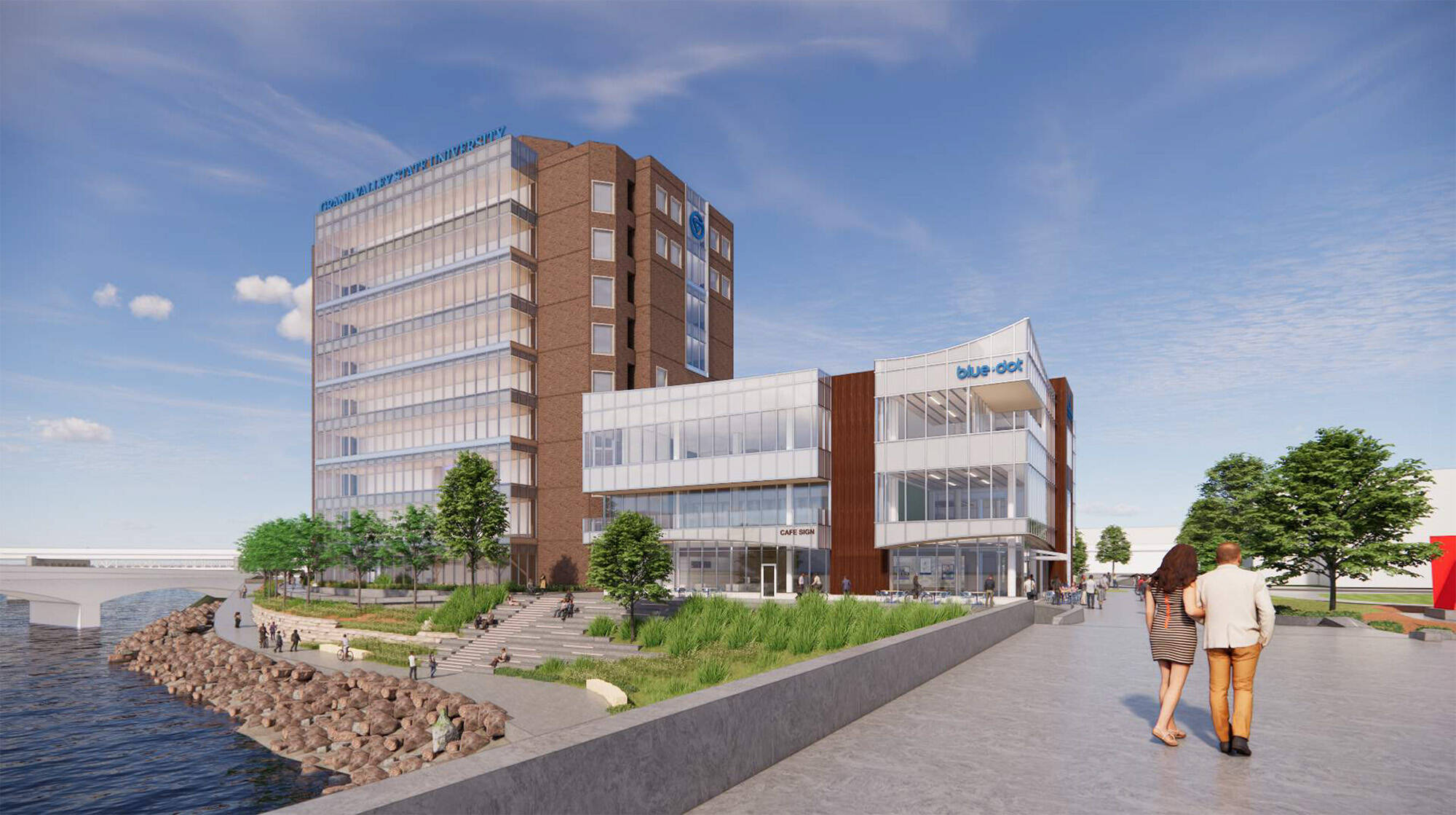
Yesterday at Tradeline’s Science & Engineering Facilities conference here in Nashville, I shared the stage with our good friend Eric Kunnen, Senior Director of IT Innovation and Research at Grand Valley State University to talk about the school’s Blue Dot Innovation Lab – the exciting new tech hub GVSU is building on its downtown Grand Rapids campus – and how telling the story of that facility can make it a powerful recruitment, retention, and revenue tool for the university.
Early in our work together, the GVSU team told us something I think every campus project team can relate to. They were thrilled about what Blue Dot would do for students, faculty, and the community. But they worried it would be hard to explain. There is so much happening inside the Blue Dot Lab that someone walking by, seeing only “Innovation Lab” on the sign, won’t know what it means or why it should matter to them.
That’s the question we set out to answer: how do you make a building tell its story, so that it can begin working for your organization before it’s built and continue working years down the road.
Setting the Stage: Why the stakes are higher than ever in higher education & for Grand Valley State University
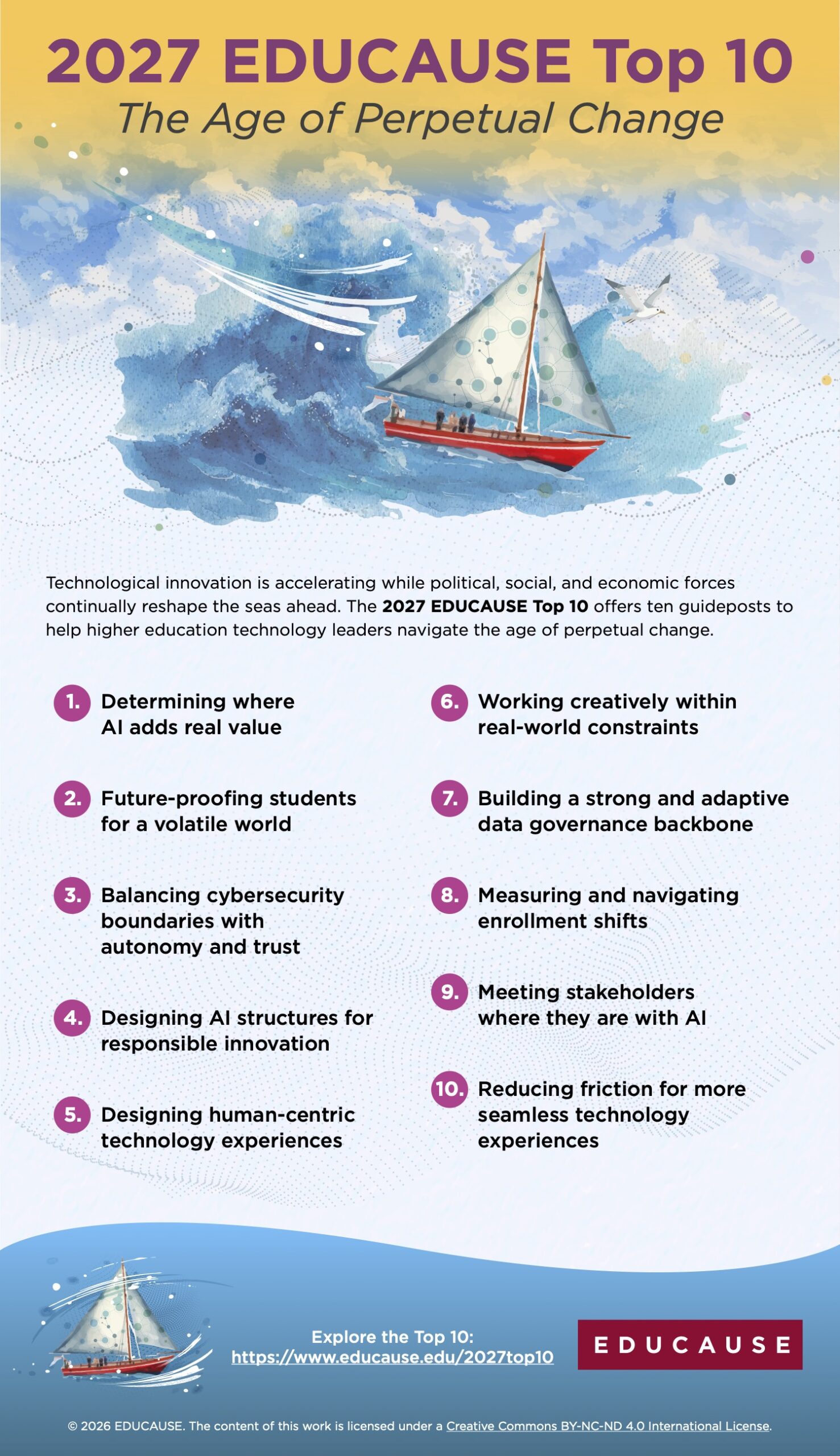
Eric opened our presentation by discussing three forces of major change in higher education from EDUCAUSE’s recently released Top 10 report. Each of these three forces are also inspiring the Blue Dot project:
- The Enrollment Cliff: Fewer traditional high school graduates are seeking traditional higher-ed experiences, however the same number of colleges are competing for them, and budgets run largely on tuition.
- Workforce Expectations & Degree Value: Families are asking whether a four-year degree leads to a job, and the workforce students will graduate into will almost certainly not be the same as when they enrolled.
- Technology Change & AI Transformation: AI is obviously the big one, but every technology shaping the digital experience of a campus is changing rapidly as well.
For GVSU, the local stakes matter just as much, if not more so. The Right Place, West Michigan’s economic development organization, says Grand Rapids needs three times its current tech talent to keep up in a region that is rapidly becoming one of the largest tech hubs in the midwest.
The Blue Dot Innovation Lab was conceived to meet all these challenges head on. Located inside GVSU’s soon-to-be renovated Everhard Center – which sits directly across the river from Grand Rapids’ largest business and industry leaders – Blue Dot will unify campus tech learning and innovation initiatives that have historically been operating in silos. With 250,000 square feet and a $160 million price tag for the renovation project, the facility can’t just look great. It has to work for the university, for the students and for the surrounding region.
Here are three principles that guided how Advent designed the experience and storytelling scope for the Blue Dot Lab that your project team should be considering:
1. Your Story is Your Superpower
At Advent, we believe story is an organization’s most powerful tool for connecting people emotionally to its mission. We find that applicable to virtually every industry, including science and engineering, where there is often a language barrier between the people doing the work and the people whose buy-in the work absolutely needs.
The way to hurdle that barrier is identifying, then effectively telling your organization’s story.
We accomplish this with our clients through a process called StoryMining, which happens at the very beginning of every project. The goal of StoryMining is to dig past the surface-level questions and get to the why behind the work. During this process, your team should be sitting down and talking with faculty, staff, and students – of course – but also community members, economic development partners, prospective donors, and corporate partners as well.
Why? Because that second group is comprised of the people you’ll need buy-in from to achieve your vision for the project, and it’s most likely also the group where the language barrier between what you’re doing and why you’re doing it is the largest.
These conversations not only help identify key storytelling touchpoints, but can also help that second group clear the language barrier and see your vision for the project.
One of my favorite design details at Blue Dot came straight out of StoryMining. The name comes from the famous Pale Blue Dot photo, Earth seen as a speck from Voyager 1 at the edge of the solar system. So a life-sized astronaut will welcome guests inside the lab, a reminder that all this technology exists to serve one planet and the people on it.
That’s a powerful way to connect anyone to Blue Dot’s vision – from a student to a stakeholder – and it all starts with storytelling.
2. Drive Impact Through Design Intentionality
Once you know your story, get specific about who you’re telling it to. Sit down with your team and rank your audiences: primary, secondary, and tertiary. Who matters most? Who can’t we forget?
For Blue Dot, that list runs from current students, faculty, and researchers to prospective students, alumni, donors, corporate partners, community members, and the local economic development council. Too often, teams stop at the people who will use the building every day and don’t think about the larger community the project will be benefitting.
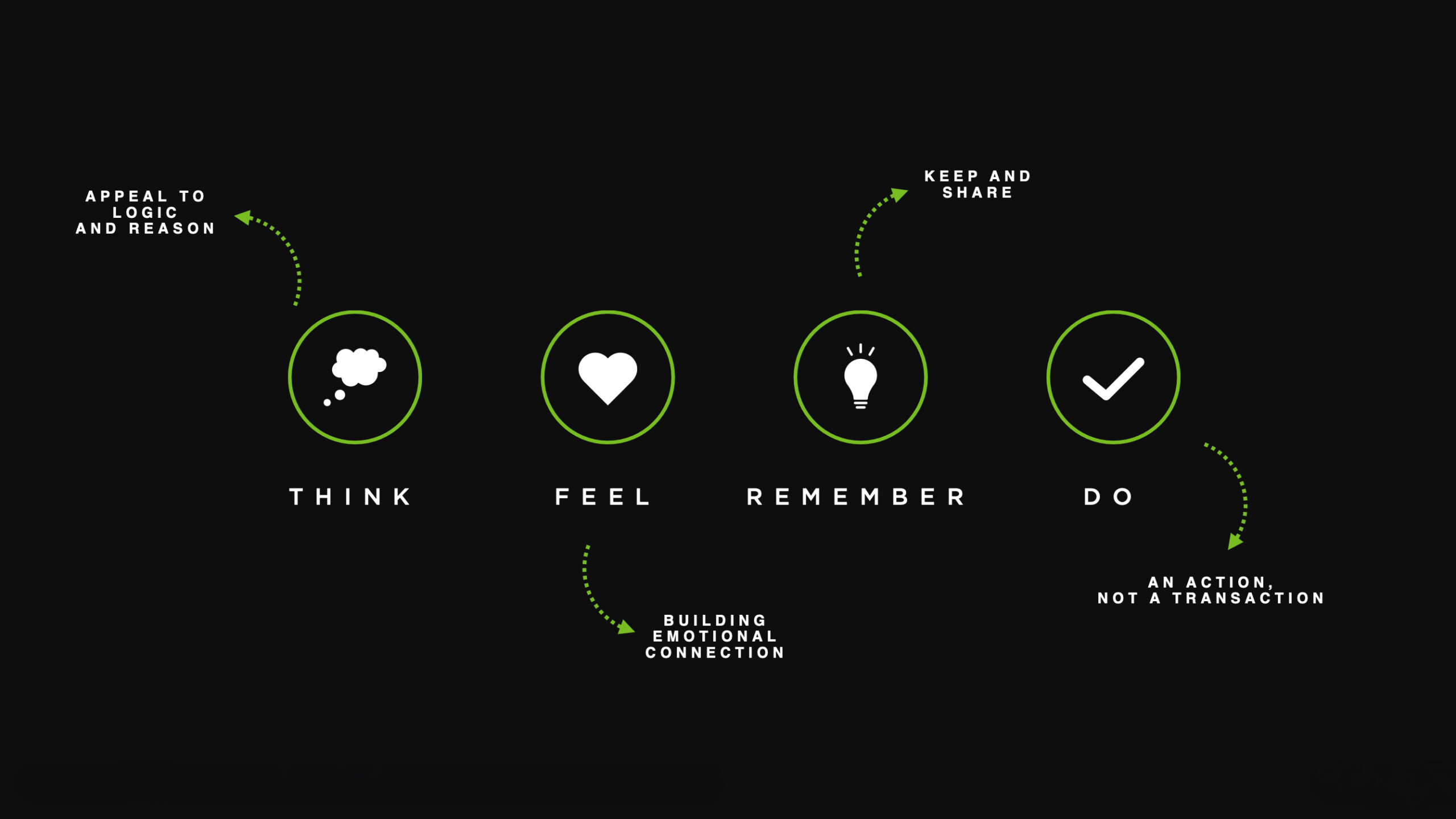
Once you’ve identified your audiences, run each of them through four key design lenses:
- Think: What do we want them to know when they leave? This is the logic: the stats, figures, and data.
- Feel: What emotional connection do we want them to have? If you run a research lab, you might think this one doesn’t apply. It does. Your work directly affects humanity, and that comes with built-in connection.
- Remember: What will they keep and share? A photo they’ll take, or something they’ll come back to see the next time they’re on campus.
- Do: What action do we want them to take? Apply, accept a faculty position, make a gift, or sign on as a corporate partner.
Many experiential graphics scopes begin and end with way-finding, information or an announcements screen. Looking at the space through Think, Feel, Remember and Do turns those same surfaces into tools that move people.
3. Put your project through the CARE Framework
New facilities face a lot of pressure to be state of the art, so “integrate lots of cutting-edge technology” becomes a bullet point that gets checked off perhaps a bit too quickly. What rarely gets discussed is the content on those screens, or what that content is supposed to accomplish.
Think about the arms race in arena video boards: bigger, brighter, stranger shapes – you name it. Everybody wants to have the flashiest video boards, but the most effective moment on any jumbotron is still the kiss cam, the dance cam or the interactive game, when 20,000 seats shrink into one human moment. Without that kind of intent, you end up with a very expensive TV scrolling a PowerPoint (or worse, a black screen in your lobby). CARE is how we avoid that. Here’s how it works:
Curate: plan the audience journey. Renowned sociologists Chip and Dan Heath teach that great brands decide what story to tell before deciding how to tell it. For Blue Dot, we mapped stories directly onto the floor plan: entry points, exits, how people move through the space, and where each story beat should land. Every touchpoint is assigned to Think, Feel, Remember, or Do.
Amaze: surprise and delight. No matter how old we are, we all want those wow moments. We want to be surprised and delighted by our experiences, especially by something we didn’t see coming. At Blue Dot, there are many such moments that amaze. One of them is The Immersive Cube®. Step inside and you’re standing in a building that doesn’t exist yet, walking through the finished Blue Dot while the real one is still under construction. It’s the kind of moment donors, prospective students, and corporate partners talk about long after they leave.
It will also be the first Immersive Cube on a college campus in the nation, and its biggest impact comes after the ribbon cutting. Once Blue Dot opens, students will create content for the Cube, bring classes inside it, and use it to show off their own work. The Cube itself is fairly simple technology. The content is what makes it powerful, and at GVSU, students will be the ones making it. That’s exactly the hands-on tech learning Blue Dot was built for: preparing students for a workforce that’s changing at an unprecedented clip.
Reward: let your audience take the wheel. The next generation of students expects a personalized experience. At GVSU’s Student Services Building on the main campus, we installed a touchscreen with three portals, so several people can explore the content they care about at the same time. It also acts as a portal to Blue Dot downtown, with content managed from both locations, so prospective students on campus tours learn Blue Dot’s story well before they’ve committed to the school.
Engage: go beyond a transaction of information. This is where the first three come together. A screen full of facts asks people to read. An engaging experience invites them to take part: to explore, play, create, and walk away smiling. The test is simple. When someone leaves your space, did they take in information, or did they have an experience? Campuses often save that kind of experience for the stadium or arena and treat academic and research spaces as places to inform. But the moments that make people care about your mission matter just as much in a lab or a lecture hall, and they’re just as possible there.
Steal Our Process
That was literally a slide in yesterday’s deck, and I meant it. None of these frameworks require a consultant.
Run StoryMining interviews with a wide circle of stakeholders. Identify your audiences and run each one through Think, Feel, Remember, Do. Then hold every part of your facility to the CARE framework. The results should be a project that not only looks good, but works too.
A huge thank you to Eric and the GVSU team for being such great partners, and to everyone who joined us at Tradeline yesterday. If you’re on a team or with an organization planning a science, engineering, or innovation facility and want to talk through how to best tell its story, I’d love to hear from you.

Written by Grace Johnson, Senior Client Engagement Manager
For over 25 years, Advent has been creating emotionally resonant experiences for leading brands including AT&T, Fanatics, the Dallas Cowboys, and Stanford University. Our proprietary StoryMining methodology ensures that every project starts with the story, not the technology.