

Experience Design
Halls of Fame
Higher Education
10,000 Messages a Day, Zero Remembered
In the first article of this series, we established that your brand doesn’t live in your brand guide. It lives in the minds and hearts of your audience, built from every interaction they’ve ever had with you, shaped by every touchpoint you’ve either designed or left to chance. Once you accept that, a harder question follows immediately.
If your audience holds your brand, how do you reach them?
Most organizations answer that question by sending more messages. More campaigns. More content. More touchpoints in the funnel. They treat attention as a numbers game: put enough in front of enough people and some of it will stick.
The average American sees approximately 10,000 brand messages every single day. Ten thousand! Your carefully crafted mission statement is competing with 9,999 other claims for attention and belief. And almost none of it lands. Daily. One last time for good measure. Ten thousand!!!
The problem isn’t volume. The problem is the medium. Messages inform. Experiences transform. And in a world drowning in messages, authentic experiences are rare enough to be genuinely powerful.
Why Our Brains Ignore Most Brand Messages: The Curse of Knowledge at Work
In 1990, Elizabeth Newton conducted what became known as the Tapping Study as part of her Stanford PhD dissertation. She divided participants into two groups: tappers and listeners. Tappers were given a list of well-known songs like “Happy Birthday” and “The Star-Spangled Banner” and asked to tap out the rhythms on a table. Listeners had to guess the songs from the taps alone.
Before the exercise began, the tappers predicted that listeners would correctly identify about 50% of the songs. The actual recognition rate was 2.5%.
Not even close.
The reason is what researchers call the curse of knowledge. When you know something deeply, you forget what it feels like not to know it. The tapper hears the full melody in their head, with lyrics and instrumentation and emotional associations. The listener hears random knocks on a table.
This is what’s happening every time your organization sends a message about itself. You’re the tapper. You know the song intimately. Every feature, every differentiator, every reason someone should care. You tap it out, confident and clear. Your audience hears noise.
The only way to bypass the curse of knowledge is to stop transferring information and start transferring feeling. Stories do this. Experiences do this. A well-crafted message, no matter how precise, cannot.
Your brain is a meaning-making machine, not a hard drive. It doesn’t store data. It stores significance. And the fastest path to significance isn’t a message. It’s a moment.
What Do People Actually Remember? Emotionally Charged, Share‑Worthy Moments
Think about what Apple Photos or Facebook surfaces when they show you “Remember this from seven years ago?” Never a screenshot of a spreadsheet. Never a photo of a presentation deck. Always moments. Always emotion. Always story.
The algorithm isn’t sentimental. It’s accurate. It knows what your brain actually stored as significant. And it’s never a brand message.
Cornell researchers found that when people photograph and share experiences, those memories become more vivid, with shared experiences recalled with greater accuracy than unshared ones. What’s interesting is that the photograph itself isn’t what does it. It’s the act of marking something as worth sharing. When you decide a moment is worth documenting, your brain strengthens the neural pathway and files it as: this mattered. This is why everyone at concerts holds up their phones. They’re not just recording. They’re encoding.
The implications for how organizations communicate are significant.
Want to be remembered? You have to create moments worth remembering.
Those moments don’t come from messaging. They come from design, from intentionality, from a commitment to creating experiences that bypass the rational filter entirely and land somewhere deeper.
The Story of the Donor Moved by a Life‑Changing Experience, Not a Name on a Door
When we work with universities on donor recognition, we offer them a piece of advice that usually makes them uncomfortable at first.
People of wealth don’t spend their entire careers building something so that at the end of their lives they can have their name put on a conference room door. That’s not what moves them. What moves them is their emotional connection to that institution, how it changed their life, what it made possible.
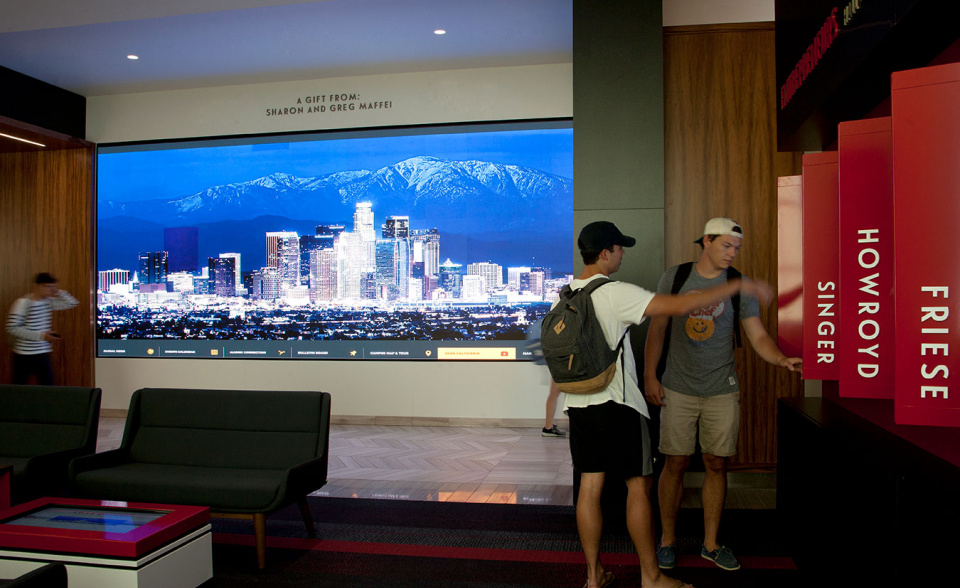
Lloyd Greif’s office overlooks Los Angeles like a promise kept. When we sat down with him to talk about his relationship with USC’s Marshall School of Business, we expected to hear about ROI and strategic philanthropy. What we heard instead was a story about a scared kid who almost didn’t make it.
“I was a scholarship kid. You know what that meant back then? It meant you didn’t belong. There was this professor. First semester. Accounting. I was failing. Not struggling, failing. And he pulled me aside after class and said, ‘Greif, you’re smarter than these grades. What’s going on?’ Nobody had ever asked me that before.”
That professor tutored Lloyd for free, every Tuesday and Thursday for three months. Today, Lloyd Greif’s name is on buildings at USC and his donations run into the millions. But when asked why he gives, he didn’t mention tax deductions or naming opportunities.
“Every check I write is a Tuesday night in that professor’s office. Every dollar is saying to some kid like me: you’re smart enough to be here.”
A donor responding to a message? No, that’s a human being whose identity was transformed by an experience, and who has spent decades trying to replicate that transformation for others. No fundraising campaign could have produced that. No tagline. No case statement. Only an experience, and then the story that grew from it.
What Are the Three Questions Your Audience Is Asking? Do You See, Hear, and Value Me?
Oprah Winfrey stood at the Harvard commencement podium in 2013 (it really is worth watching) and distilled thirty years of interviews with presidents, celebrities, and ordinary people into three questions. Not three answers. Three questions.
“Do you see me? Do you hear me? Does what I say matter?”
Every person she’d ever interviewed, she said, was asking themselves the same three things. The CEO in the corner office. The fan in the nosebleed section. The first-generation college student walking onto campus. The donor considering whether to give again.
When organizations come to us wondering why their donors aren’t giving, why their fans aren’t showing up, or why their students aren’t enrolling, I bring them back to those three questions. They usually want to talk about campaigns and messaging and value propositions. I want to talk about belonging. Because thirty years of building experiences has taught me one thing clearly: belonging isn’t a nice-to-have, it’s your business model.
Messages cannot answer Oprah’s questions. Only experiences can. A message tells someone what you want them to know. An experience makes them feel seen, heard, and like what they say actually matters.
Answer those questions with your experiences, not your messaging, and you don’t just have customers. You have family.
Why Stories Transform and Bullet Points Don’t: Turning Data into Lived Experience
That headline above reads like an article in itself… or maybe our next slogan? Anyway, back on track… Every time I see another presentation built on hockey-stick graphs and market penetration analyses, I think about what it actually takes to move a human being from passive observer to committed believer.
Data validates. Stories motivate. Logic explains why something should matter. Stories make you feel why it does. Researchers have proven that stories disarm in a way that data simply cannot. When you hear a story, your brain doesn’t process it as information to evaluate. It processes it as experience to inhabit. Neural coupling, the synchronization of the listener’s brain activity with the speaker’s, only occurs with narrative. Never with a feature list.
This isn’t a case against data. I love data. I built a career on research-driven design. But data without story is just noise. It joins the other 9,999 messages competing for attention and loses.
The most powerful experiences we’ve ever created weren’t the most technologically sophisticated ones. The bronze sword embedded in a column at USC’s Heritage Hall cost $3,000. Athletes touch it every day on the way to practice without being told to. Recruits are warned by current players: touch the sword, it’s tradition. That object carries more brand meaning than any campaign USC has ever run because it creates a felt experience, not a communicated one.
The Heisman trophies left exposed and touchable at USC’s Heritage Hall, no glass case, just a security tether, generated hundreds of thousands of shared photos. Budget constraints became brand explosion. People doing the Heisman pose next to a trophy they could actually touch. That moment answered Oprah’s three questions simultaneously. I see you. I hear you. You belong here.

How to Shift Your Communication from Messaging to Designing Meaningful Experiences
If you’re leading an organization and you’re still primarily investing in messaging, a few things are almost certainly true. Your audience has largely tuned you out. They’re skilled at it. They’ve had a lifetime of practice filtering the 10,000 daily messages that aren’t for them. Your carefully crafted language is hitting the same wall as everyone else’s.
The shift isn’t complicated, but it requires a different kind of discipline. Instead of asking “What do we want to say?” start asking “What do we want them to feel?” Instead of building campaigns, build moments. Instead of communicating your values, create experiences that let your audience discover those values for themselves.
Younger audiences especially can spot inauthenticity from across the room. They didn’t grow up trusting institutions or their messaging. They grew up trusting experiences, their own and the ones their networks shared. If what you’re saying doesn’t match what they feel when they interact with you, no amount of message discipline will close that gap.
In the end, we don’t remember what people said. We don’t remember what they showed us. We remember how they made us feel.
That feeling is what moves people. And moving people is the only marketing that has ever truly worked.

For over 25 years, Advent has been creating emotionally resonant experiences for leading brands including AT&T, Fanatics, the Dallas Cowboys, and Stanford University. Our proprietary StoryMining methodology ensures that every project starts with the story, not the technology.